
INDUSTRIES
Connect Client Work, People, Projects, and Financial Performance
Project-based professional services firms depend on getting the right people onto the right work while keeping delivery, time, billing, and project performance aligned. Connect the systems behind your client lifecycle so teams can manage work with better visibility from opportunity through delivery.
INDUSTRY OVERVIEW
Your people drive the business.
Your systems should support them.
In a project-based services business, the path from a new opportunity to profitable delivery crosses multiple teams. Sales needs to understand what was sold. Delivery needs the right scope and resources. Employees need simple ways to record time and expenses. Finance needs accurate information for billing and project performance.
When those steps live in disconnected CRM, project-management, time-tracking, accounting, and reporting systems, teams spend more time reconciling information and less time managing the work itself.
A connected operating model gives your teams a clearer view of the client relationship, project commitments, resource demand, delivery progress, and financial performance without forcing every process into the same application.

INDUSTRY CHALLENGES
Great client work requires more than great people.
Growth becomes difficult when sales, staffing, delivery, time, billing, and finance operate from different information. Small gaps at each handoff can turn into utilization problems, billing delays, scope confusion, or margin surprises later in the project.
Opportunity-to-Project Handoff
Important scope, pricing, staffing assumptions, and customer commitments can get lost when an opportunity becomes a delivery project and sales information does not carry forward cleanly.
Resource Planning & Utilization
Teams need visibility into availability, skills, workload, and upcoming project demand to assign the right people without consistently overloading some resources and underusing others.
Project Visibility
Project managers need a dependable view of scope, schedule, progress, effort, and changing requirements instead of piecing together status from separate tools.
Time & Expense Capture
Delayed or inconsistent time and expense entry affects project reporting, billing, forecasting, and the ability to understand what work is actually costing.
Billing & Contract Management
Fixed-price, time-and-materials, milestone, and other billing arrangements require project activity and commercial terms to stay aligned so invoicing does not become a manual reconciliation exercise.
Project Profitability
Revenue alone does not show whether work is healthy. Teams need visibility into planned versus actual labor, expenses, billing, and other project economics before margin problems are discovered after delivery.
MICROSOFT SOLUTIONS
Connect your projects, people, and financial operations.
Professional services technology should support the complete flow from opportunity through project delivery and financial performance. Depending on your operating model, that may involve Dynamics 365 Sales, Project Operations, Business Central or another financial system, Power BI, and Power Platform working together rather than one application being forced to do everything.
Project & resource management
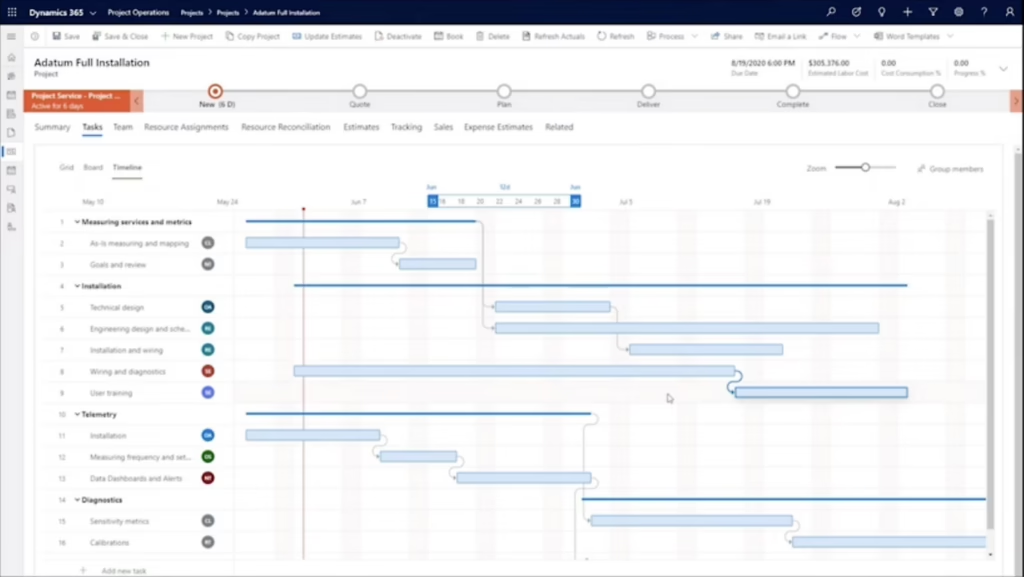
Use Dynamics 365 Project Operations to support project planning, resource scheduling, time and expense tracking, project-based sales, and delivery workflows where it fits your operating model.
Financial management
Connect project delivery with accounting, purchasing, billing, and financial reporting so project activity can be understood alongside the broader financial performance of the business.
Client relationship management
Use Dynamics 365 Sales to manage opportunities, accounts, contacts, activities, and pipeline information and create a stronger handoff between sales and project delivery.
Reporting & automation
Use Power BI, Power Automate, and Power Apps to bring information together, reduce appropriate manual processes, and give teams clearer visibility into project and operational performance.
WHY PRENTICEWORX
Your business is built on expertise.
So is ours.
Professional services systems have to reflect how the business actually sells and delivers work. That means understanding what happens when an opportunity becomes a project, how resources are assigned, how time and expenses are captured, how clients are billed, and how leadership evaluates project performance.
PrenticeWorx starts with those operating questions before choosing the technology. The goal is to connect the client lifecycle without creating unnecessary process, duplicate information, or another system your teams have to work around.
OUR APPROACH
Your business comes first.
Technology follows.

1. Understand
Map how opportunities become projects, how work is planned and staffed, how time and expenses are captured, how clients are billed, and how project performance is measured today.
2. Design
Define which systems should own sales, projects, resource information, financial processes, and reporting—and determine how those systems should work together.
3. Implement
Configure the agreed applications, connect the required systems and data, validate the critical client and project workflows, and prepare your teams to work in the new environment.
4. Support
Continue improving workflows, reporting, integrations, automation, and system configuration as your teams, client work, and operating model evolve.
Frequently Asked Questions
Microsoft business applications can support project-based organizations that manage client relationships, projects, resources, time, expenses, billing, and financial performance. The right configuration depends on how your organization sells work, delivers projects, staffs teams, and bills clients.
Dynamics 365 Project Operations includes capabilities for project planning, resource scheduling, project progress, time tracking, expenses, project-based sales, pricing, and invoicing. The specific capabilities available depend on the deployment model and connected financial environment.
Yes. Project Operations supports project-contract and invoicing workflows for common project-based billing arrangements, including time-and-material and fixed-price models, with additional billing schedules and rules depending on the deployment and configuration.
Yes, but the architecture depends on your financial system and Project Operations deployment. The important first step is defining which application owns project, billing, accounting, and financial data and how that information needs to move between systems.
Yes. PrenticeWorx can assess an existing Microsoft environment to identify process, configuration, integration, reporting, and adoption issues and determine where improvement may be possible.
LET’S TALK
Connect the Business Behind Your Client Work.
Start with the handoffs creating the most friction—from sales and staffing to project delivery, time, billing, and financial reporting.